Balancing Freelance Work and Life: Achievable Goals
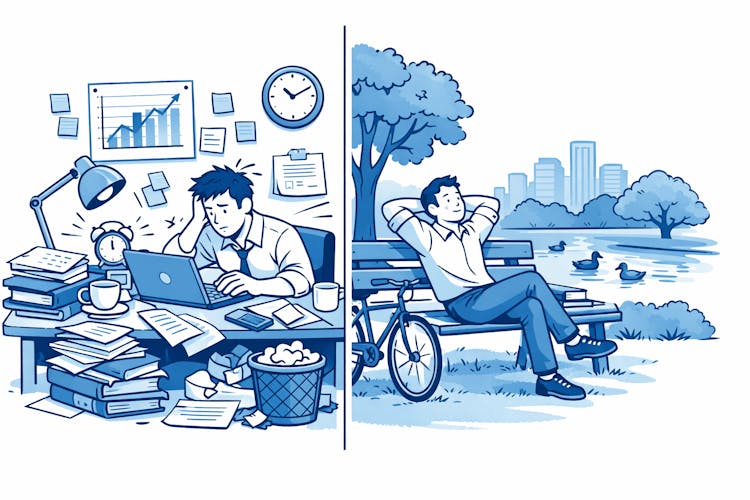
Why Freelance Life Challenges Traditional Work-Life Balance Advice
Typical work-life balance tips often cater to employees—clock out on time, switch off from work. But for freelancers, there's no designated end to the workday, no boss urging you to head home, or coworkers covering shifts.
The difference is clear: An employee balances between work and life. A freelancer, meanwhile, wears multiple hats as salesperson, accountant, marketer, and customer support, all whilst attempting to maintain a personal life.
Thus, the notion to simply 'down tools at five' falters here. Yet, a personal system tailored to your freelance schedule can work wonders.

Achieving work-life balance isn't about reducing hours. It's about taking control of what and when you work, ensuring you reserve time to recharge.
The Four Pillars of True Work-Life Balance
Picture a table standing firmly on four legs. If one leg shortens, imbalance ensues.
1. Time: Your Most Coveted Asset
Contrary to the fear of working too little, freelancers often mismanage it, spending hours on invoices instead of engaging clients.
Solutions include:
Time Audit – Log activities in half-hour intervals for a week. The insights might surprise you.
Three Priorities Rule – Each day, pinpoint three key tasks, and consider anything beyond as a bonus.
Time Blocking – Allocate devoted time slots for tasks (e.g. Monday morning for admin, Tuesdays for client meetings).
2. Energy: Uneven Hours Demand Smart Use
An hour’s work at 8 a.m. is more fruitful than at 4 p.m. Yet, many begin their days with trivial tasks, saving crucial work for exhaustion-filled afternoons.

Graphic designer Petra reserved her mornings for creative tasks (8–12) and left emails and admin for post-lunch. This change enabled her to complete a third more projects without losing evening family time.
3. Relationships: The Veiled Order of Work Life
Though rarely discussed, relationships often suffer first. The phrase “just one more thing” echoes all too often in freelancers’ households.
Helpful tip: Instill non-negotiable rituals—shared dinners, weekend strolls, and device-free Wednesday nights, treating them as top-client appointments.
4. Health: The Underappreciated Cornerstone
Being the business's all-in-one role implies missing sick leave or substitutes. Alas, many freelancers skip exercise, miss sleep, and choose coffee over meals.

Burnout doesn't denote weakness. Research shows over 40% of entrepreneurs face burnout symptoms. Prevention trumps treatment—and keeps you from missing weeks of work.
Establishing Boundaries with Clients—Securing Relationships
Freelancers often dread, “If I'm not available round the clock, clients will stray.” In truth, clients value those who maintain firm boundaries.
Strategies include:
Specify availability beforehand. Announce in your email signature or on your website: “Responses provided within 24 hours during business days.”
Invest in a separate work phone or delineate working hours on your mobile. Calls after 6 p.m. cease.
Embrace “I’ll tackle that tomorrow”, offering measured replies rather than immediate ones. Urgency rarely aligns with importance.
Copywriter Tomáš switched from promising 2-hour responses to 24-hour business day replies—maintaining all clientele but gaining tranquil evenings and weekends.
Embrace Automation: Free Time with Technology
Repetitive tasks that consume time and energy can often be automated or simplified, creating room for personal time.
Often time-wasting tasks include:
Manual billing and payment tracking
Re-entering client details
Sending recurrent reminders
Compiling monthly financial reports
With tools like MyInvoiceOnline, invoices are a click away, due dates are tracked automatically, and financial summaries are instantly available. Save administration time to enhance your work-life balance.
Review a typical week, pinpoint recurring identical tasks. Consider them for automation or delegation.
Quick Test: Gauge Your Work-Life Balance
Answer these four candid queries:
Time: Do you truly track your weekly working hours? (Hint: most underestimate by 10-15 hours.)
Energy: Do you accomplish your vital tasks when you're most energised?
Relationships: Have you spent at least one work-free evening this week?
Health: Do you consistently sleep 7+ hours and exercise thrice weekly?
If “no” appears twice or more, rethink plans today, not tomorrow.
Achieving work-life balance isn't a one-off feat. It's an ongoing process, and that's perfectly alright. The key is an active commitment to the balance.
FAQ
Is achieving work-life balance as a self-employed professional realistic?
Yes, although it takes a different form than in traditional employment. Instead of fixed schedules, it relies on intentional control over your time, energy, and boundaries.
How many hours should a self-employed person work each week?
There’s no standard benchmark. What truly matters is the effectiveness of your work, not the number of hours. The focus should be on productive output rather than time spent at your desk.
How can I handle clients who reach out in the evenings or on weekends?
Establish clear communication rules from the outset. If those boundaries are already blurred, reshape them gradually—for instance, stop replying after a set hour and respond the following day.
Can working from a coworking space improve work-life separation?
For many freelancers, having a dedicated workspace outside the home makes a significant difference. It helps create a clear psychological divide—leaving the space signals the end of the workday.
What are the signs that I might be heading toward burnout?
Common indicators include persistent tiredness, a more negative or detached attitude toward work, reduced efficiency, irritability, and disrupted sleep. Spotting these signals early allows for timely intervention.
Is maintaining balance possible during particularly busy periods?
In high-demand phases, perfect balance is unlikely. The focus should shift to preserving essential habits—such as sufficient sleep—and planning recovery time once the workload decreases.
Which tools can support time management for self-employed individuals?
The right tools depend on your workflow. Time tracking apps like Toggl or Clockify, task managers such as Todoist or Trello, and invoicing tools like MyInvoiceOnline can all help. The key is simplicity—use a limited set of tools consistently.
Should self-employed individuals plan vacations?
Yes, it’s highly beneficial. Schedule your time off in advance, notify clients early, and activate automated responses. Even a short break can improve clarity, energy, and long-term productivity.