How to Stay Focused When Working From Home
Why focus is harder at home
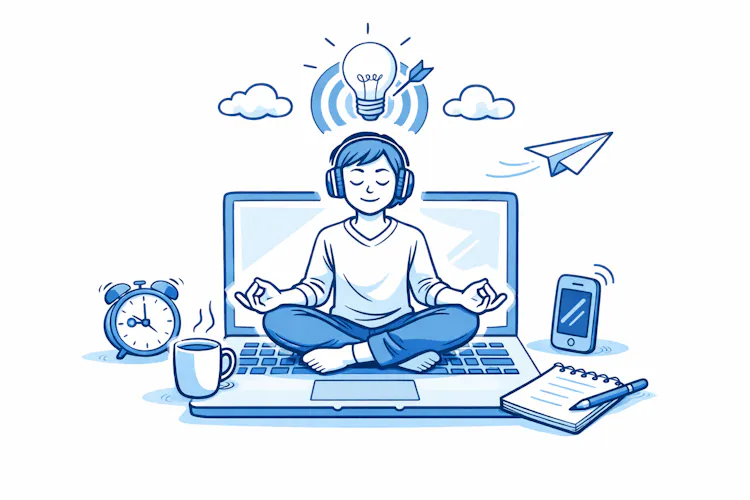
At home there are more distractions than at the office: the washing-up, the laundry, the fridge, a pet and a phone no one is watching you check. You also lose the natural boundary a commute provides, the signal to your brain that says “now I am starting” and “now I am done”. Without those rituals, work tends to bleed across the whole day, and your focus suffers.
The good news is that focus can be supported with the right environment and routine. It is not about iron willpower, it is about a few smart habits.
Set up a space that tells your brain “it is time to work”
The foundation is a dedicated workspace. If you work in a different spot every day, the sofa today, the bed tomorrow, your brain never links any place with work, so switching into focus mode is harder. A separate desk with a comfortable chair, good lighting and minimal clutter is ideal. Even in a small flat, one corner you use only for work does the job.

Plan your day and protect time for deep work
Without a schedule, the day fragments into dozens of interruptions. Break it into blocks: start with a short morning routine (coffee, a walk, a to-do list), then a block of focused work, and only after that handle emails and calls. Save your hardest task for when your energy peaks, which for most people is mid-morning.
Try the Pomodoro Technique
A proven method for holding attention is Pomodoro: work for 25 minutes with no interruptions, then take a 5-minute break. After four rounds, take a longer break of 20 to 30 minutes. Short intervals are easier to sustain, and regular breaks prevent burnout.

Example
Tame digital distractions
The biggest attention thief is usually your phone and its notifications. Every “I will just check social media for a second” pulls you out of deep work for far longer than the unlock itself takes.

Take breaks, but the right kind
A break does not mean swapping work for your phone; your brain does not rest that way. Instead of scrolling, stand up, stretch, get some water or look out of the window. A short walk recharges your attention far more than another ten minutes staring at a screen.
Separate work from home
When work and downtime blur together, both suffer, your focus and your rest. Set a clear end to your working day and stick to it. An “end-of-day ritual” helps: close the laptop, tidy the desk, go for a walk. It tells your body and mind that work is over.

Working from home and looking for a way to keep order and focus at work? Find out how to build a system that will actually work for you.
How long should I work in one block?
Around 25 to 50 minutes of focused work followed by a short break works well. Shorter intervals (Pomodoro) are easier to sustain; longer blocks suit people who need to dive deeper into a task. Try both and see what fits.
Does music help with focus?
For many people, yes, especially instrumental music or ambient sound that masks household noise. Lyrics, on the other hand, distract some people. Experiment with music, white noise or silence.
What if I cannot isolate myself from family at home?
Agree clear signals with your household for when not to disturb you (a closed door or headphones, for example). If that is not enough, consider working from a library or coworking space for your most demanding tasks.
Why is it so hard to get back to work after an interruption?
It can take your brain 15 to 20 minutes to return to deep focus. That is why it pays to prevent interruptions, turning off notifications and setting aside uninterrupted blocks, rather than repeatedly ramping back up.