Artificial intelligence tools for small businesses
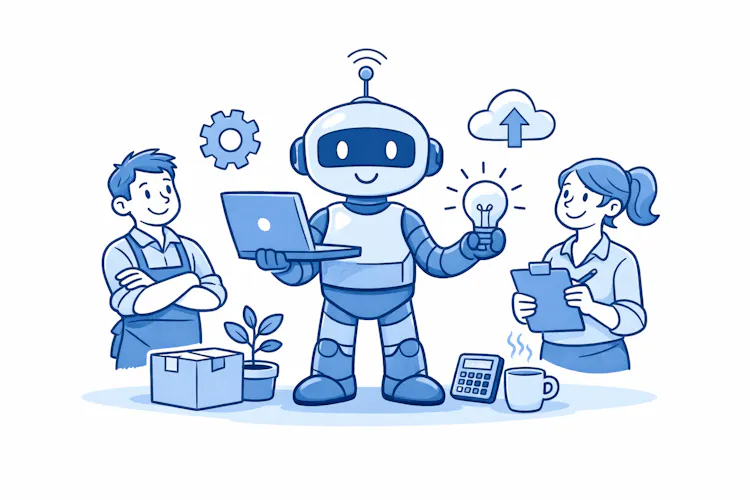
Navigating the range of AI tools is becoming increasingly difficult as they emerge faster than we can follow. These tools offer the greatest benefit to small businesses and sole traders by performing tasks that would otherwise require hiring additional staff. Most of them do not require technical skills and offer a free trial version.
This overview presents tried-and-tested AI tools, categorised by the areas in which they can provide the most help. For each tool, you will find information on its suitability, usefulness, and whether it offers a free version.

The stated prices are indicative and for most tools are charged monthly. The exact amount and range of features change quickly—check the current pricing on the respective tool's website.
Writing and communication AI assistants
Text assistants are the most versatile category. They can help with drafting emails, product descriptions, social media posts, summarising long documents, and responding to frequently asked customer questions.
ChatGPT is the most well-known universal assistant. It handles a wide range of tasks and offers image generation, web search, and conversation memory in its paid version. A free version is available, with the paid plan starting at a lower price point, roughly several hundred pounds a month.
Claude by Anthropic excels in working with long documents, careful reasoning, and writing longer texts. It has a free version with daily limits, and the paid plan starts at a lower price range, roughly several hundred pounds a month.
Gemini by Google is most beneficial if you work within Gmail and other Google applications, with which it is closely integrated. The free version is among the most generous on the market, and the paid plan is within the same price range as other text assistants.

For most small business owners, one paid text assistant is sufficient. Start with the free version and switch to the paid one only when you encounter real limitations. A well-phrased request in the free version often outperforms a poorly crafted query in the paid version.
AI tools for image and graphic creation
Almost every entrepreneur needs visuals—be it for social media posts, banners, or website images. AI graphic tools can turn text descriptions into finished images.
Canva is the easiest choice for non-technical users. In addition to image generation, it offers a whole suite of tools for text editing, layout design, and creating marketing materials. It has a free plan but with limited credits.
Adobe Firefly is a good option if you need assurance around commercial use—Adobe trains its model only on licensed content. The free account offers a limited number of credits per month.
Midjourney provides the highest quality artistic and photorealistic outputs but is more geared towards demanding users. It doesn't offer a free version, but the entry-level price is cheaper than common text assistants.
AI in invoicing and accounting
Even the administration around invoices can be simplified. Modern invoicing and accounting tools use AI, for example, for automatic data extraction from invoices, categorisation of transactions, payment reminders, or cash flow forecasting.

Advanced AI-driven features are now offered by accounting platforms like QuickBooks or Xero, which automatically extract data and suggest postings. Even the invoicing tool MyInvoiceOnline fits this trend—aiming to simplify the issuing and management of invoices to reduce the time entrepreneurs spend on administration.

Impact of artificial intelligence on invoicing processes — How AI automates invoice issuing, monitors payments, and reduces errors.
AI for customer service
If you receive many repetitive queries, an AI chatbot can resolve part of the communication without human involvement. Modern tools learn from your knowledge base and can independently solve a substantial portion of common questions.
Tidio with the Lyro assistant is among the most affordable choices for small e-shops and businesses—it combines live chat and an AI agent in one. The paid plans start at a higher price range than typical text assistants, but they are accessible by chatbot standards.
Intercom with the Fin assistant is one of the most powerful ready-made options, especially suitable for companies already using Intercom. It charges by the number of resolved conversations, so you pay more for results.

AI for productivity and automation
The final category connects your other tools together and automates routine tasks.
Zapier links thousands of applications and can automate repetitive tasks—for example, automatically adding a contact to a database and sending a notification when web forms are completed. Automations can now be created using plain language. It offers a free plan for basic tasks, with paid plans in a similar price range as common text assistants.
Notion with built-in AI is suitable if you already manage notes, projects, and documentation in it. AI helps with organising information, summarising, and writing. Its AI features are a paid add-on in the lower price range, cheaper than a standalone text assistant.
Meeting transcription tools (such as Fireflies or similar) automatically transcribe meetings and extract action items. Many have a usable free version.
Free vs. paid: What to choose
Today's free AI tool versions are intentionally useful—they are meant to keep you within their ecosystem. They are often sufficient for starting and testing. Paid plans typically offer higher limits, access to the best models, and advanced features.
Practical rule:
Start with free versions, choose one main paid tool based on what consumes most of your time, and add others only when you reach real limitations. It's pointless to pay for five tools when you can fully utilise one.
Recommendations by business type
Sole trader or sole proprietor can begin with one text assistant (ChatGPT, Claude, or Gemini) and a graphic tool like Canva. These will cover most daily tasks—writing, ideas, and visuals.
Small e-shop will benefit from an AI chatbot for customer service and automation that links orders to other systems, saving manual transcriptions.
Growing business with administration should focus on AI in invoicing and accounting, as well as productivity tools that save time for the entire team.
Artificial intelligence is not a magic solution, but a well-chosen tool can indeed save you time and money. The key is to select based on actual needs, rather than what's in vogue.