Deciphering Math Jargon: Understanding Calculation Outcomes
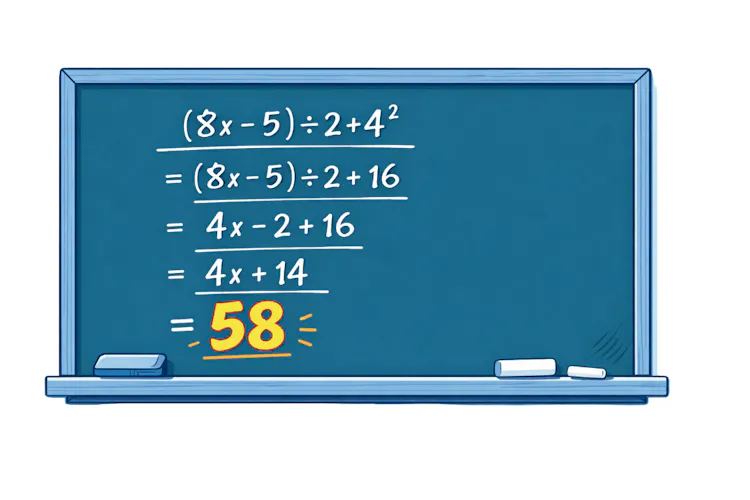
Many individuals often mix up mathematical jargon. Do you actually know which of these terms truly signifies the outcome of a calculation? Typically, the phrase 'result of calculation' pertains to expressions such as 'answer,' 'output,' or 'solution.' Let's delve into these terms in detail:
Answer: Commonly used in basic arithmetic to denote the numerical conclusion from simple operations like addition or subtraction.
Output: A broader expression often utilised in mathematical functions, referring to the result when inputs are processed by a function.
Solution: This is a precise term used for the value(s) that resolve an equation or solve a problem.
Value: This indicates the specific number or symbolic expression derived from evaluating an equation or function.

Example
In the equation 5 + 3 = 8, the result (8) serves as the 'answer' to this addition problem.
Summary: Despite the context influencing the choice of words, 'solution' remains the main formal term for the result derived from calculations.
Which Term Marks the Endpoint of a Calculation?
Identify the precise terminology that mathematicians use to label the final output of a calculation! The term most frequently used is 'solution' or 'answer'. Regarding basic calculations like addition or multiplication, 'answer' is apt, whereas in algebraic contexts, 'solution' is more appropriate.

The outcome of arithmetic operations is typically called an 'answer,' but in the case of equations, it's termed a 'solution.'
Can You Pinpoint the Term for a Calculation Outcome?
Which expression do you think identifies the result of a calculation? Consider terms like 'output,' 'solution,' or 'result.' In determining which term means a calculation's outcome, context is crucial. However, 'result' often surfaces as the most appropriate descriptor.
Step-by-Step Interpretation:
In fundamental mathematics, the outcome of an equation like 2 + 2 = 4 is often labeled as the 'answer.'
Progressing to algebra, solving an equation such as x + 3 = 5 gives a 'solution' (x = 2).
Across various disciplines, the outcome might be generally termed as the 'result.'
Which Term Defines a Calculation's Outcome?
In what way would you describe the conclusion of a computation universally? 'Result' or 'output' are broadly accepted to explain the culmination of mathematical processes.:
Exemplar
For the equation 3 × 4 = 12, the result is 12, also referred to as the 'product.'
How Might We Articulate the Conclusion of a Calculation in Mathematical Terms?
Regardless of whether you're calculating 'x' or adding up figures, there’s always a fitting term! Mathematicians use expressions like 'result,' 'solution,' or 'output,' depending on the mathematical operation at hand. Eventually, 'result' acts as an all-encompassing term, simplifying the mathematical lexicon and ensuring clear communication across Britain and beyond.