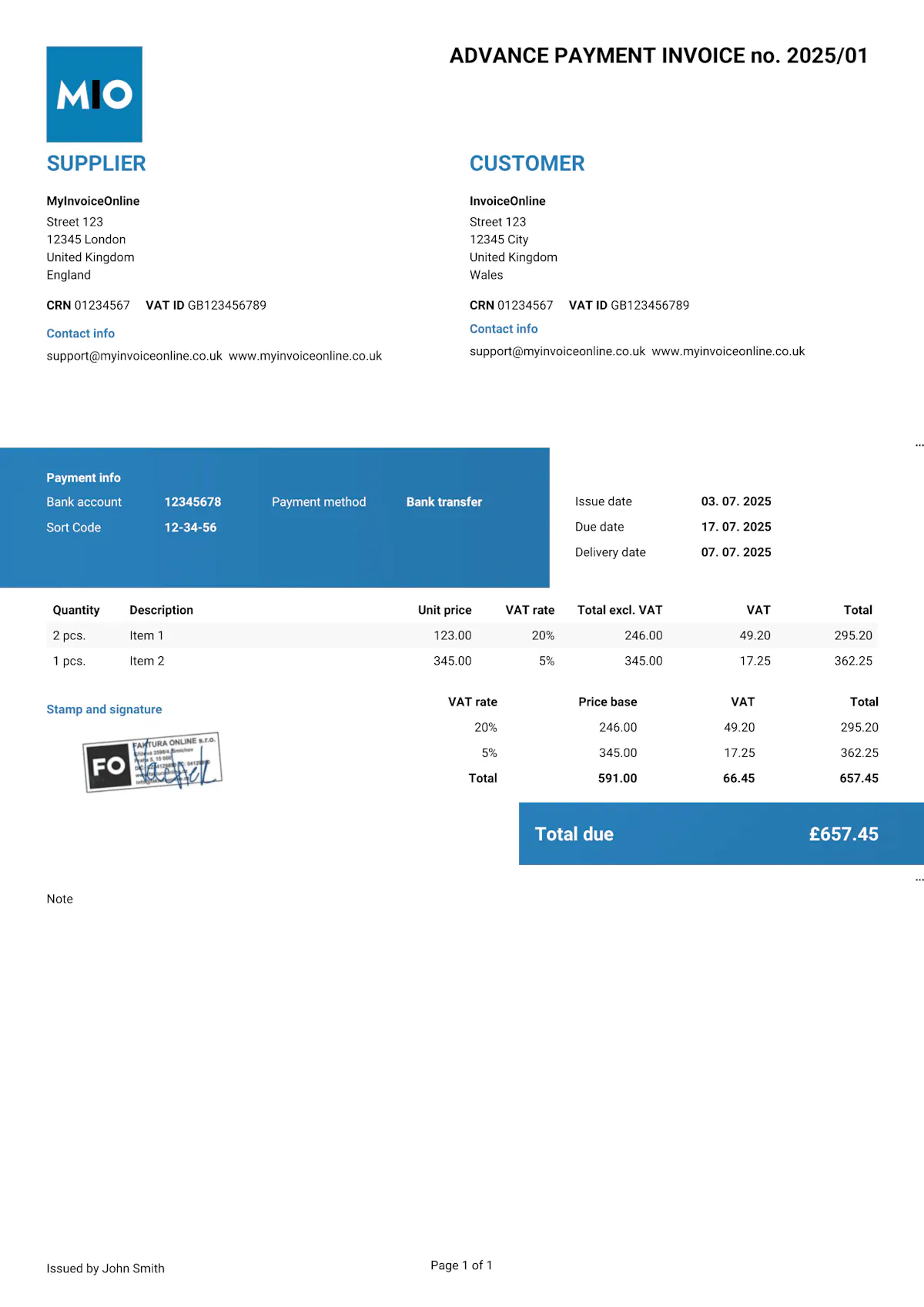
Template for invoice for advance payment
An advance invoice is a document used to request a partial payment from your customer before you deliver the goods or complete the service. It is not a tax or accounting document, so it cannot be used to reclaim VAT or as evidence for a VAT return. Its purpose is to tell the customer how much to pay, where and by when. Once the deposit is received, you issue a proper VAT invoice covering the full supply – offsetting the advance payment already made.

What should an advance invoice include?
An advance invoice has no legally prescribed format – precisely because it is not a tax document. However, to ensure the customer knows what to pay and how, it should include the following details:
Essential information
Document label – "Advance Invoice" (never "Invoice" or "VAT Invoice").
Document number – a unique reference for your records and for matching to the final invoice.
Date of issue – the date the advance invoice was created.
Payment due date – the deadline for the deposit payment.
Supplier details – business name or sole trader name, address, company number and VAT number (if registered).
Customer details – business name or full name, billing address, company number.
Description of supply – what will be delivered or provided (goods, service, project).
Deposit amount – the partial payment being requested.
Payment details – bank account name, sort code, account number and payment reference.
Recommended additional information
Unit price and quantity – for orders with multiple line items, to give the customer a clear breakdown.
Total contract value – if the deposit only covers part of the order, include the full estimated value so the customer can see what remains.
Delivery terms – expected delivery date and method.
Reference to a quote or contract – if the advance invoice follows on from a prior agreement.

An advance invoice is not a tax document. Do not label it as a "VAT Invoice". If you are VAT-registered, you issue a proper VAT invoice once the deposit is received or the supply takes place – whichever comes first – as a separate document covering the payment.
When and why is an advance invoice used?
You issue an advance invoice whenever you want the customer to pay a deposit before you fulfil the order:
Bespoke work or custom services – For high-value orders (construction work, software development, made-to-measure furniture), a deposit covers your material and labour costs before the work is completed.
New customers with no payment history – Unsure about a customer's reliability? A deposit minimises the risk of delivering and not getting paid.
Stage-based projects – For long-running projects, you can request a deposit before each stage. Each advance invoice then corresponds to one phase of the work.
Reserving goods – The customer wants to secure a specific product, and you need confirmation of genuine interest before setting it aside.
Protecting cash flow – For larger orders, a deposit ensures you have funds to cover costs before the project is finished and the final invoice is raised.

Proforma invoice vs. advance invoice: Both documents serve as a request for payment before delivery and neither is a tax document. The practical difference is that a proforma invoice is typically issued for the full amount and works more like a formal quotation with payment details. An advance invoice requests a partial payment up front, followed by a final invoice after delivery to settle the remaining balance. You can create both types on MyInvoiceOnline.co.uk.
Invoice like a professional.
Your customers will see that the invoice matches your brand.
Add your logo, brand colours or stamp in just a few seconds. The editable templates are easy to customise to suit your needs.

Your logo on every invoice
Upload your own logo and give every invoice a professional look that's unmistakably yours.

Your brand colours
Choose your brand colours so your invoices are consistent with your business's visual identity.

Add your stamp
Need a company stamp on your invoices? Simply upload it – it'll appear automatically in the right place.