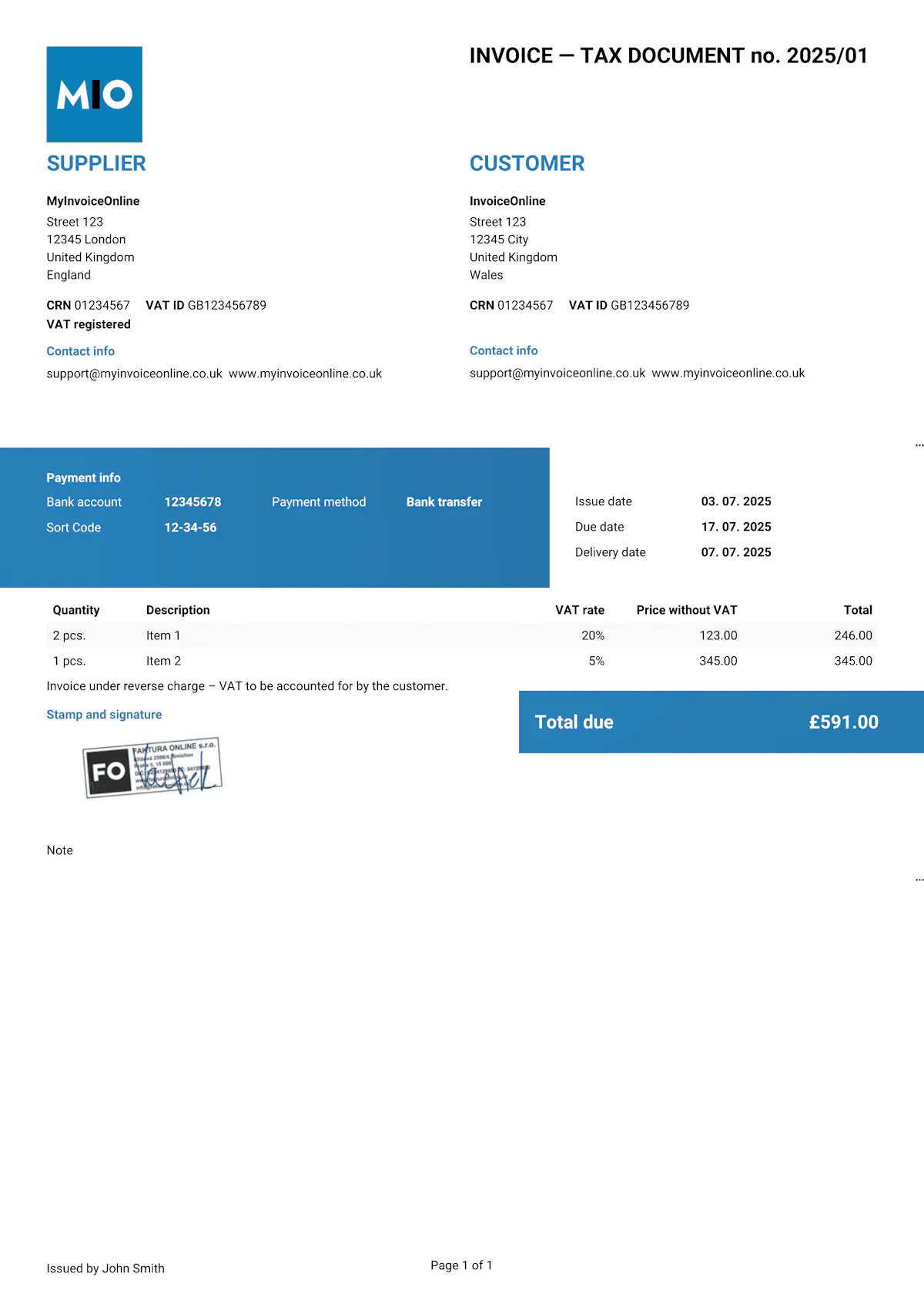
Reverse charge invoice template
A reverse charge invoice is a VAT invoice where the supplier does not charge or collect VAT – instead, the customer accounts for VAT directly to HMRC. The supplier issues the invoice showing the net amount and the mandatory statement "Reverse charge: customer to account to HMRC for VAT". In the UK, the domestic reverse charge applies in specific situations – most notably for construction services under the CIS scheme and for certain goods such as mobile phones and computer chips above set thresholds.

What must a reverse charge invoice include?
A reverse charge invoice contains the same core details as a standard VAT invoice, with one crucial difference: the supplier does not show the VAT amount. Instead, the invoice must carry a mandatory statement transferring the obligation to account for VAT to the customer.
Mandatory information
Document label – "Invoice" or "VAT Invoice".
Invoice number – a unique sequential identifier.
Date of issue and tax point (time of supply).
Payment due date – the deadline for payment.
Supplier details – business name, address, company number, VAT registration number.
Customer details – business name, address, company number, VAT registration number. The customer must be VAT-registered.
Description of supply – what was delivered or provided, quantity and unit price.
Net amount – total amount excluding VAT.
Applicable VAT rate – the rate that would have applied if not for the reverse charge (e.g. 20%).
Mandatory statement: "Reverse charge: customer to account to HMRC for VAT" – this note is a legal requirement. Without it, the invoice does not meet reverse charge conditions and the supplier may be held liable for the VAT.
Payment details – bank account name, sort code, account number and payment reference.
Recommended additional information
Reference to the relevant legislation – e.g. "Domestic reverse charge applies under section 55A VAT Act 1994" (for construction) or the relevant statutory instrument. This helps the customer's accountant identify the correct treatment.
CIS registration details – for construction reverse charge invoices, include the supplier's CIS registration status.
Purchase order or contract number – for matching with other documents.
Stamp and signature – not required but add credibility to the document.

On a reverse charge invoice, the supplier must show the applicable VAT rate but must not include the VAT amount in the total. The customer uses the rate to calculate the VAT they must account for on their own VAT return – both as output tax and input tax (so the net effect is usually nil, but both entries must be made).
When and why is a reverse charge invoice used?
The reverse charge cannot be applied at the supplier's discretion – UK VAT legislation specifies exactly when it must be used:
Construction services (CIS reverse charge) – Since March 2021, supplies of construction services between VAT-registered businesses within the Construction Industry Scheme must use the reverse charge. This covers building, alteration, repair, demolition and related services. It applies throughout the supply chain – including subcontractors – but does not apply when the customer is an end user or a connected intermediary.
Specified goods above thresholds – The domestic reverse charge applies to sales of mobile phones and computer chips where the total value of the supply exceeds £5,000. The aim is to prevent missing-trader fraud in these high-value, easily transportable goods.
Gas and electricity – Supplies of gas and electricity by a supplier who is not a utility company to a VAT-registered business fall under the reverse charge.
Emissions allowances and renewable energy certificates – Trading in carbon credits and similar environmental certificates between VAT-registered businesses uses the reverse charge.
Cross-border B2B services – When a UK business receives services from an overseas supplier, the UK business must account for VAT under the reverse charge. Similarly, when a UK business supplies services to an overseas business customer, the supply is outside the scope of UK VAT and the overseas customer accounts for VAT in their own country.

Construction reverse charge – who is an end user? An end user is a customer who uses the construction services for their own purposes and does not make onward supplies of construction services. For example, a retailer hiring a builder to fit out a shop is an end user. The end user must confirm in writing that they are an end user – otherwise the supplier must apply the reverse charge. If you are unsure, check HMRC's technical guide.

Both parties must report correctly: The supplier enters the net value of the supply in Box 6 of their VAT return (but no output tax in Box 1). The customer enters the VAT amount in Box 1 (output tax) and Box 4 (input tax), and the net value in Box 6 and Box 7. Getting the VAT return entries wrong is one of the most common errors with reverse charge invoices.
Invoice like a professional.
Your customers will see that the invoice matches your brand.
Add your logo, brand colours or stamp in just a few seconds. The editable templates are easy to customise to suit your needs.

Your logo on every invoice
Upload your own logo and give every invoice a professional look that's unmistakably yours.

Your brand colours
Choose your brand colours so your invoices are consistent with your business's visual identity.

Add your stamp
Need a company stamp on your invoices? Simply upload it – it'll appear automatically in the right place.